
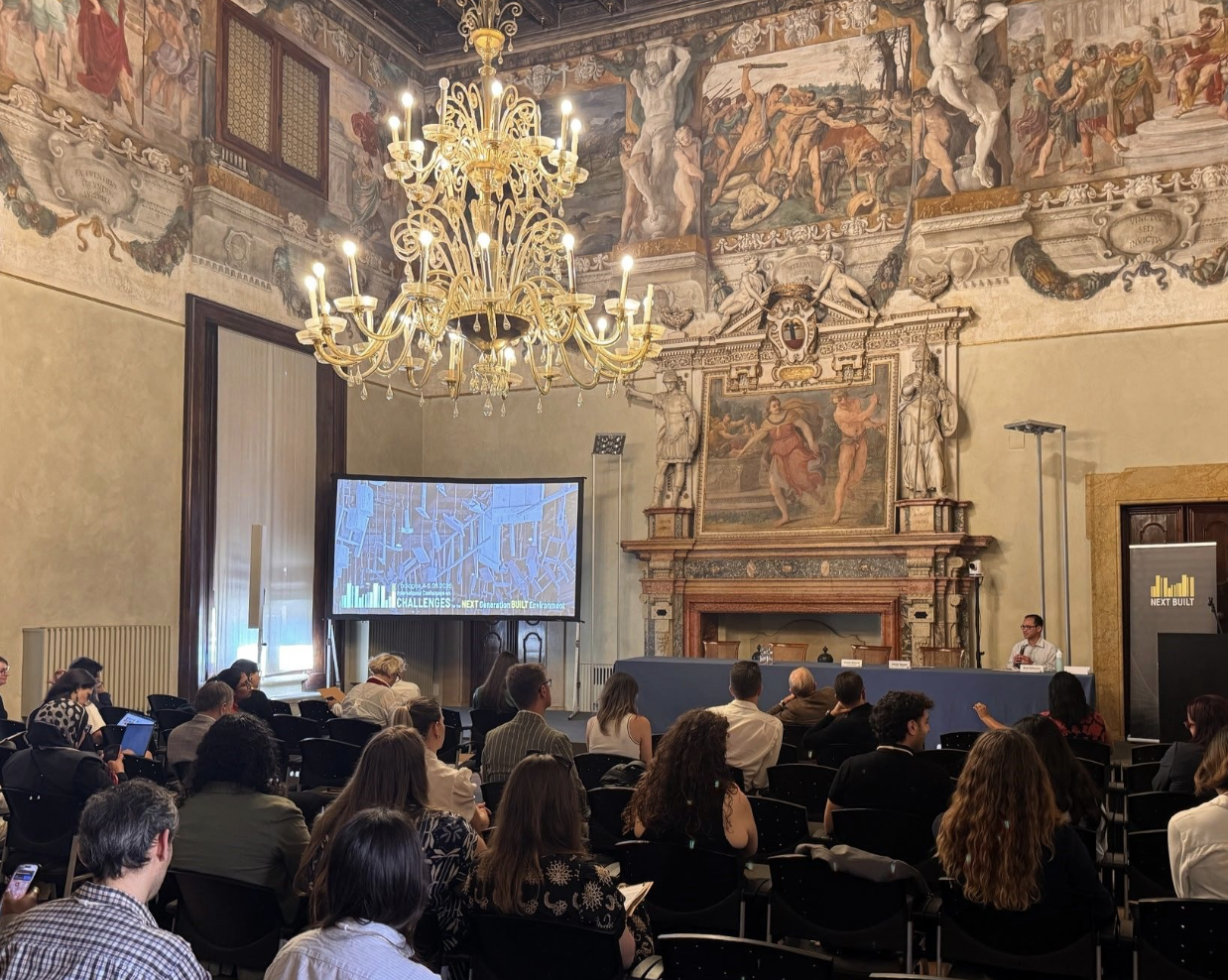
At the beginning of June, the NEXT BUILT Conference took place in Bologna, bringing together researchers and practitioners to explore some of the most pressing challenges facing the built environment.
The conference addressed a wide range of topics, including circular construction, urban liveability, public policy, data management and emerging technologies.
During the event, Rizal Sebastian, invited as a keynote speaker from the Centre of Expertise Mission Zero at The Hague University of Applied Sciences, presented recent advances in data acquisition and analysis for Digital Material, Product and Renovation Passports.
His presentation highlighted the importance of collecting, structuring and sharing reliable material data throughout the building lifecycle. From identifying materials in buildings scheduled for demolition to supporting their reuse in future construction projects, information must circulate between multiple digital platforms, stakeholders and decision-making processes.
Improving data interoperability is therefore an essential step towards enriching Digital Material Passports and facilitating the reuse of secondary construction materials.
The conference also provided an opportunity to discuss the future of digital material marketplaces. Participants explored the possible forms these platforms could take, the role of digitalisation in building trust and facilitating exchanges, and the question of who should own, manage and govern such systems.
These discussions highlighted the growing importance of digital tools and shared data in supporting a more circular, transparent and resource-efficient built environment.
The event was organised by Jacopo Gaspari, Lia Marchi and Licia Felicioni from Alma Mater Studiorum – Università di Bologna.
#SUM4Re #HorizonEurope #NEXTBUILT #CircularConstruction #DigitalMaterialPassports #DataInteroperability #MaterialReuse #CircularEconomy #BuiltEnvironment