
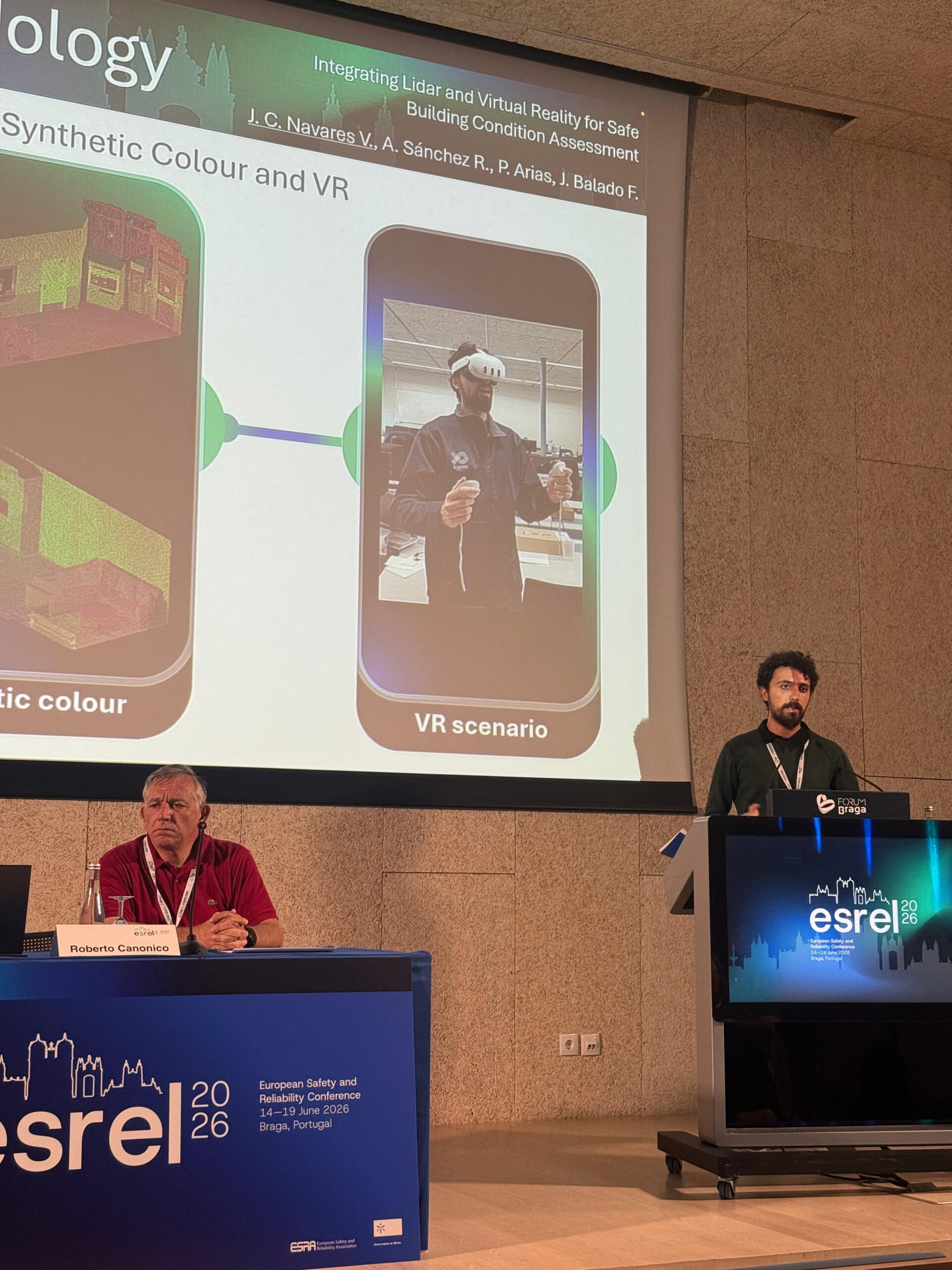
On 18 June 2026, the SUM4Re project was represented at the European Safety and Reliability Conference, ESREL 2026, held in Braga, Portugal.
During the conference, researchers from the Universidade de Vigo presented the scientific paper “Integrating LiDAR and Virtual Reality for Safe Building Condition Assessment.”
Improving the safety of building inspections
Building inspections conducted before deconstruction or material recovery operations can expose professionals to unstable structures and other potentially hazardous conditions. At the same time, these operations require accurate information about buildings, their materials and their structural condition.
The research presented at ESREL 2026 explores how digital technologies can help address this challenge by enabling inspectors to assess buildings remotely.
The proposed framework combines high-resolution LiDAR point clouds, virtual markers positioned using Mixed Reality technologies and immersive Virtual Reality environments. Together, these tools create detailed digital representations that users can explore without being physically present inside the building.
Two SUM4Re case studies
The methodology was tested at two real-life sites involved in the SUM4Re project:
- A residential building in Longyearbyen, Norway, scheduled for deconstruction due to the deterioration of its wooden foundations.
- Part of the Anoeta metro station in San Sebastián, Spain, which will be deconstructed as part of an expansion project.
The collected point clouds were integrated into a Virtual Reality environment, allowing users to move through the scanned spaces and examine their different elements remotely.
Combining realistic and synthetic colours
The research also evaluated the use of synthetic colour visualisation to highlight geometric characteristics and material differences within the point clouds.
The results show that realistic colours remain particularly useful for recognising objects and understanding their context. Synthetic colours, meanwhile, can make large geometric structures and certain material differences easier to identify.
Rather than replacing one visualisation method with another, the study highlights their complementary value depending on the objectives of the inspection.
Supporting safer and more sustainable deconstruction
The findings demonstrate that LiDAR-based Virtual Reality environments can provide a valuable solution for remote building assessment. By reducing the time spent by inspectors in potentially dangerous locations, these technologies could improve safety while supporting the collection of reliable data for material inventories, reuse and sustainable deconstruction.
The paper was authored by Juan Carlos Navares-Vázquez, Ana Sánchez-Rodríguez, Pedro Arias and Jesús Balado-Frías from CINTECX, Universidade de Vigo.
🔗 Read the full conference paper: https://cmsweb.com.sg/rps2prod/esrel2026/epro/pdf/esrel26-p26205.pdf
#SUM4Re #HorizonEurope #ESREL2026 #LiDAR #VirtualReality #DigitalTwin #BuildingInspection #SustainableDeconstruction #CircularConstruction